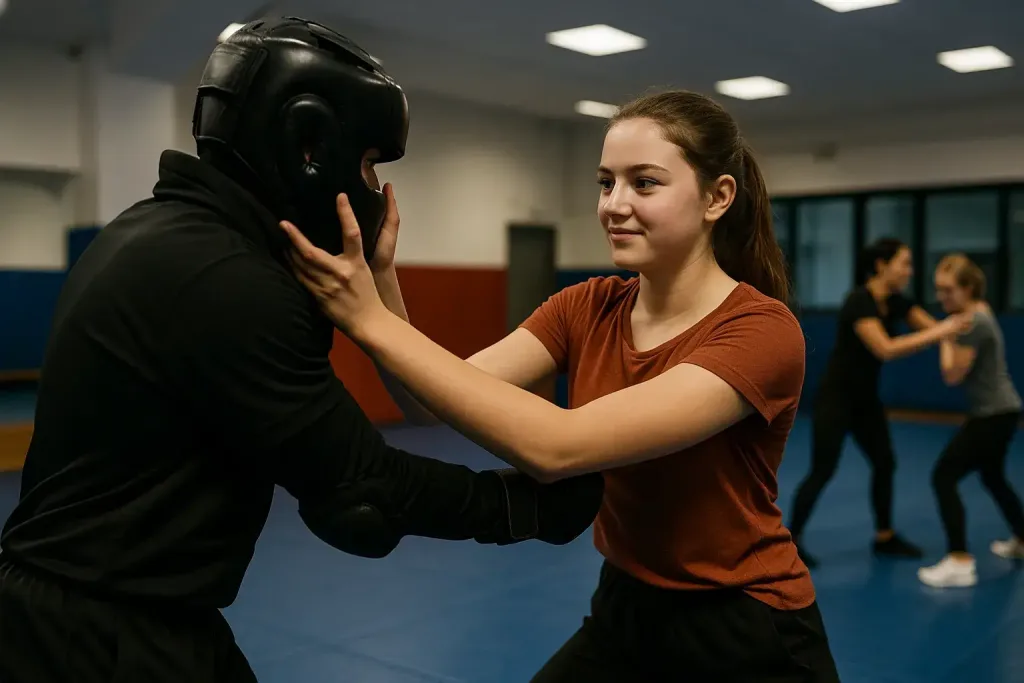
Practical Personal Safety, Self-Defense and First Aid Training — A Guide for Moscow
Why teach personal safety, self-defense and first aid in Moscow?
— Urban life brings everyday risks: crowded transport, late commutes, unfamiliar neighborhoods and seasonal weather hazards.
— Teaching these skills increases confidence, reduces panic, and improves outcomes after emergencies.
— Integrated training (awareness + physical skills + first aid) emphasizes escape and survival rather than confrontation.
Core learning goals
— Situational awareness and risk reduction: preventing threats before they escalate.
— Verbal de-escalation and boundary-setting: stay safe without physical conflict when possible.
— Practical, proportionate self-defense: efficient escapes, release techniques, and safe physical responses when necessary.
— Basic life-saving first aid: recognizing emergencies, stabilizing injured people, performing CPR, controlling severe bleeding, and summoning help.
— Legal and ethical understanding: what self-defense means under Russian law, and how to act responsibly.
Recommended course structure (example: 12 sessions)
— Session 1: Personal safety mindset, situational awareness, planning routes, and phone safety.
— Session 2: Verbal assertiveness, boundaries, bystander intervention basics.
— Session 3–5: Fundamentals of body mechanics, balance, falling safely, breakaways from grabs.
— Session 6–8: Simple, effective defensive moves focused on creating opportunities to escape; practice with partners and pads.
— Session 9: Women’s- and seniors-specific adaptations, mobility limitations and alternatives.
— Session 10: First aid basics — assessing scene safety, calling for help, recovery position, treating shock.
— Session 11: Hemorrhage control (direct pressure, tourniquet awareness), burns, fractures and immobilization.
— Session 12: CPR and AED overview, scenario training combining self-defense and first aid, legal/ethical review.
— Ongoing: refresher drills, mock scenarios, and physical conditioning.
Teaching methods that work
— Experiential, scenario-based training that simulates realistic environments (public transport, stairwells, elevators).
— Progressive drills: start slow, emphasize technique, then increase speed/intensity safely.
— Role-play to practice de-escalation and bystander roles.
— Small groups for personalized feedback.
— Certified instructors for first aid and for combative skills; cross-training with medical personnel for realism.
— Emphasize escape and avoidance over “fighting to win.”
First aid essentials to cover (high-level)
— Priorities: ensure scene safety, call for help, preserve life, prevent worsening, prepare for handover to professionals.
— Emergency numbers in Russia: 112 (unified emergency number) and 103 (ambulance). Use whichever is appropriate.
— CPR (adult, high level): check responsiveness; if unresponsive and not breathing normally, call emergency services, start chest compressions — depth ~5–6 cm, rate 100–120/min, uninterrupted compressions; 30 compressions : 2 rescue breaths if trained; use AED as soon as available.
— Severe bleeding: apply direct pressure, use dressings; if life-threatening extremity bleeding, a tourniquet can be used when trained.
— Recovery position for unconscious breathing patient; monitor airway and breathing until help arrives.
— When in doubt, prioritize calling emergency services and keeping the person warm and monitored.
Instructor and venue guidance (Moscow-specific considerations)
— Look for instructors who are:
— Certified by recognized bodies (first aid instructors certified by reputable organizations; self-defense instructors with credible martial arts/safety credentials).
— Experienced in adult education and scenario training.
— Insured and able to provide references or student outcomes.
— Venues: community centers, university sports halls, licensed gyms and dojos, corporate training rooms. Ensure good lighting, non-slip floors, mats for physical practice and a separate classroom for lecture components.
— Consider partnerships with local organizations (e.g., Russian Red Cross groups, university safety offices, municipal centers) for credibility and access to certified first-aid trainers.
Legal and ethical considerations
— Emphasize avoid, escape, call for help. Physical force must be proportionate to the threat.
— Russian law permits necessary self-defense, but exceeding necessary measures can have legal consequences. Encourage learners to seek local legal guidance for detailed rules or complex cases.
— Respect privacy and consent in training; do not record or publish images of participants without permission.
Special populations and accessibility
— Children: focus on awareness, how to ask for help, safe routes, and age-appropriate escape techniques — prioritize avoidance, not fighting.
— Women-only classes: safe spaces can increase participation and cover gender-specific scenarios.
— Seniors and people with disabilities: adapt techniques to mobility, emphasize environmental safety and reachable prevention strategies.
Measuring success and sustainability
— Use pre- and post-training self-efficacy surveys and practical skill assessments.
— Offer periodic refreshers (every 6–12 months) and short drills for retention.
— Build a local network of graduates to practice scenario drills and reinforce community safety norms.
How to get started in Moscow
— Identify target audience (schools, workplaces, neighborhoods).
— Find certified first-aid trainers (look for Russian Red Cross chapters or other verified providers) and reputable self-defense instructors.
— Pilot a short workshop (half-day) combining awareness, a simple physical module, and a first-aid clinic; collect feedback and iterate.
— Promote via local community boards, schools, workplaces and social media — highlight safety outcomes rather than aggressive tactics.
Conclusion
Teaching integrated personal safety, self-defense and first aid empowers people across Moscow to reduce risk, respond calmly to threats, and save lives. Prioritize prevention, proportionality, and competent instruction — and pair physical skills with legal awareness and basic medical training for the best results.