Teaching Personal Safety, Self-Defense and First Aid in Moscow: A Practical Guide for Instructors and Organizers
Why teach these skills in Moscow now
Moscow is a large, dynamic city where people of all ages confront everyday risks — from crowded transport to late-night commutes. Teaching personal safety, pragmatic self-defense and basic first aid:
— *reduces fear and increases confidence;*
— *prepares people to prevent or escape threats;*
— *enables immediate lifesaving action before emergency services arrive.*
Core goals for any program
— Build situational awareness and risk avoidance habits.
— Teach non-violent options and de-escalation as first choices.
— Train simple, effective escape-focused self-defense skills.
— Provide certified basic first aid and CPR training.
— Cover legal responsibilities and rights under Russian law to help students act safely and lawfully.
Key content areas
1. Personal safety and prevention
— Urban awareness: reading environments, scanning exits, trusting instincts.
— Routine safety habits: travel plans, sharing location, avoiding isolated routes, safe use of public transport.
— Digital safety: secure messaging, avoiding oversharing travel plans on social media.
— Home and workplace security basics: locks, lighting, door safety, visitor verification.
2. Verbal de-escalation and boundary setting
— Using calm, assertive language and body language to reduce tension.
— Setting clear boundaries, simple phrases to create distance, and using voice to attract attention.
— When to disengage and retreat.
3. Practical, escape-focused self-defense
— Emphasis: *escape, not competition.* Priority is creating time and space to get away.
— Balance, stance, and breaks in grappling scenarios.
— Simple strikes and movements that enable a disengage (open-palm push, heel of palm to chin, low stomp to unbalance) — taught in controlled practice emphasizing safety.
— Releases from common grabs and holds focused on creating opportunities to run.
— Use of improvised everyday items for distraction or to protect (keys, bag) — safety-first approach.
— Special modules: women’s safety, seniors’ mobility-limited strategies.
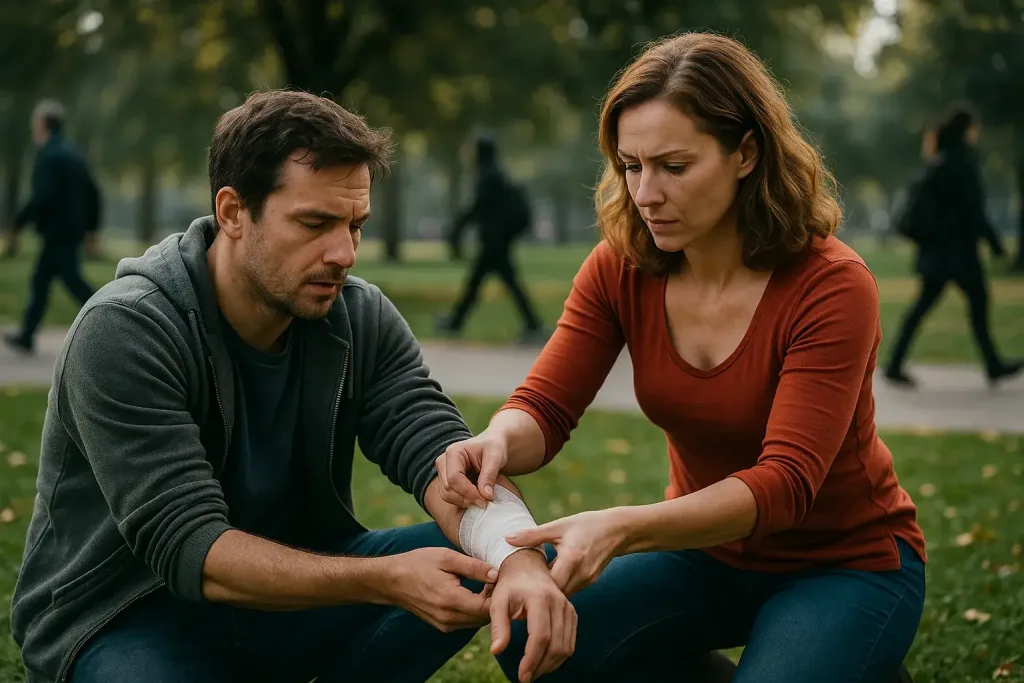
4. Basic first aid and emergency response
— Scene safety and assessment.
— Calling emergency services: 112 (general emergency), 103 (ambulance) — give clear location and condition.
— Primary survey: responsiveness, airway, breathing, circulation.
— CPR basics: chest compressions at ~100–120/min, depth ~5–6 cm for adults, compressions-to-ventilations ratio 30:2 (or hands-only if untrained). Emphasize training with a certified course for full technique.
— Controlling severe bleeding: direct pressure, elevation, and applying a tourniquet only if trained and necessary.
— Management of choking, shock, fractures, burns, and hypothermia — teach recognition and basic stabilizing measures.
— Importance of hygiene and preventing infection when giving first aid.
Legal and cultural considerations in Russia
— Explain the principle of necessary defense (необходимая оборона) and the requirement of proportionality — avoid encouraging excessive force.
— Encourage documentation and reporting: how to file police reports in Moscow and when to contact legal counsel.
— Respect local norms and languages; provide materials in Russian (and other languages used by your students) for clarity.
Instructor qualifications and safety standards
— Instructors should have: recognized self-defense/martial arts credentials, first aid/CPR certification (e.g., Red Cross, local health authority), and experience in adult education.
— Maintain a ratio that allows safe supervised practice (e.g., max 10–12 students per instructor for hands-on).
— Use protective gear for contact drills and emphasize non-injurious practice.
— Require informed consent and collect medical/health disclaimers.
Where to run classes in Moscow
— Community centers (районные ДК), gyms and dojo spaces, university halls, corporate training rooms, and outdoor parks (season permitting).
— Partner with public institutions: local police precincts for safety lectures, the Russian Red Cross for first aid certification, and municipal youth centers for outreach.
Suggested formats and sample syllabus
— One-off workshop (3–4 hours): personal safety + brief self-defense drills + 1.5–2 hour basic first aid/CPR.
— 6–8 week course (weekly 90–120 min): weeks 1–2 awareness & prevention, weeks 3–5 practical escape skills & scenario practice, week 6 legal & de-escalation, week 7 first aid basics, week 8 certification simulation and review.
— Ongoing drop-in practice sessions for skills maintenance.
Promotion and community outreach
— Partner with employers, universities, expat communities and women’s groups.
— Use social media, local bulletin boards, and flyers in metro stations and community centers.
— Offer free taster sessions to build trust and convert to longer courses.
Partnerships and resources in Moscow
— Российский Красный Крест — first aid and CPR training.
— Municipal health services and district police for legal-safety briefings and referral.
— Local gyms and martial arts schools (judo, sambo, krav maga, karate) for physical training space and cross-promotion.
— Volunteer and neighborhood safety organizations for outreach.
Safety, ethics and risk management
— Prioritize non-violence, escape and summoning help over bodily harm.
— Do not instruct students to carry or use weapons; focus on avoidance and lawful options.
— Keep classes trauma-informed: allow students to opt out of drills, provide psychological safety, and offer referrals to support services when needed.
Quick-start checklist for organizers
— Confirm instructor certifications (self-defense + first aid).
— Secure venue and liability insurance or waivers.
— Prepare