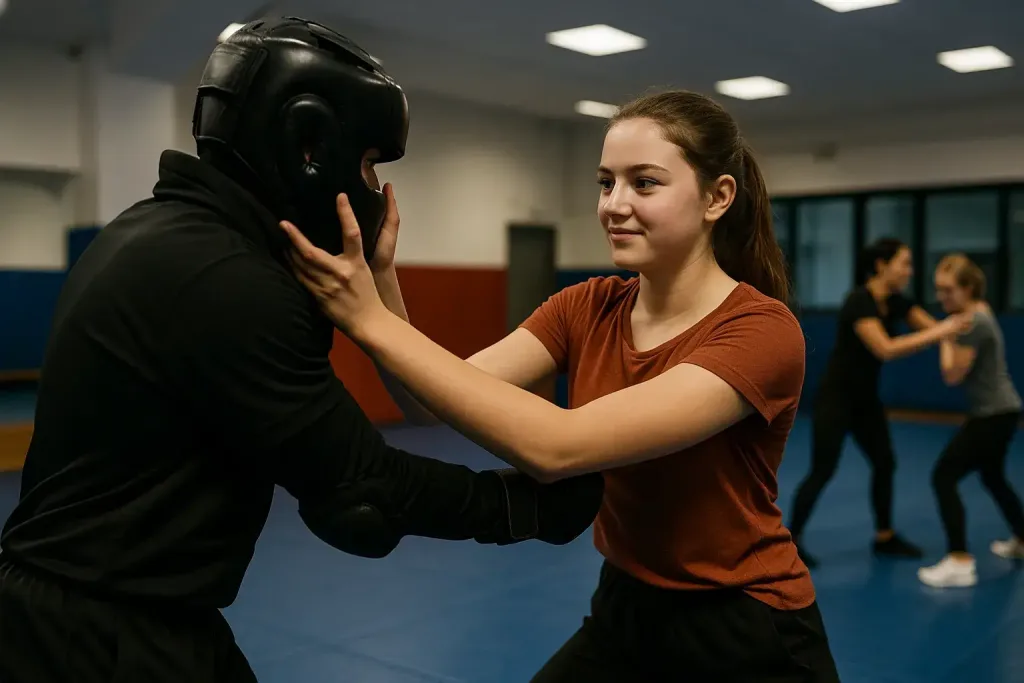
Teaching Personal Safety, Self‑Defense, and First Aid in Moscow: A Practical Guide for Instructors and Organizers
Введение
This guide is for instructors, community organizers, schools and employers in Moscow who want to run practical, lawful and effective courses in personal safety, self‑defense and basic first aid. It covers curriculum design, local context and legal considerations, recommended training partners, and practical tips — all aimed at increasing personal confidence and saving lives.
Why combine the three topics?
— Personal safety (prevention and awareness) reduces risk before a confrontation occurs.
— Self‑defense builds the skills and mindset to survive an assault while remaining within legal bounds.
— First aid ensures participants can preserve life and limit harm if an injury occurs.
Together they form a rounded, responsible program.
Moscow‑specific context
— Common urban risks: crowded metro pickpocketing, street harassment, late‑night transit exposure, scams in tourist areas.
— Emergency numbers: 112 (unified emergency). Also commonly used: 102 (police), 103 (ambulance), 101 (fire).
— Legal basics: Russian law recognizes necessary defense (необходимая оборона). Use of force must be proportionate; excessive force can lead to criminal liability. Emphasize de‑escalation and escape as primary goals.
— Items for self‑defense: non‑lethal personal protection devices (e.g., pepper spray / перцовый баллончик) are commonly used in Russia but check current local rules and restrictions before recommending or carrying them.
Target audiences and learning outcomes
— Teenagers (school programs): situational awareness, avoiding risky situations, basic first aid, confidence building.
— Adults (community, corporate): verbal de‑escalation, simple defensive moves to break free and escape, CPR and major bleeding control.
— Vulnerable groups (seniors, women, people with disabilities): tailored mobility‑appropriate tactics and accessible first aid.
Learning outcomes should be measurable: recognize threats, perform primary survey, start CPR, control severe bleeding, perform safe escape techniques, call emergency services.
Core curriculum (recommended modules)
1. Orientation and legal/ethical framework (1 hr)
— Legal limits of self‑defense in Russia, when to call police, duty of care.
2. Situational awareness and prevention (2 hrs)
— Risk recognition, environment scanning, travel safety for metro and night transit, smartphone and travel app use, buddy systems, basic anti‑scam awareness.
3. Verbal de‑escalation and boundary setting (1.5–2 hrs)
— Voice, stance, assertive language, creating opportunities to exit.
4. Basic physical self‑defense principles (3–4 hrs)
— Movement, balance, creating distance, simple, high‑probability responses to create escape opportunities. Avoid teaching offensive techniques; focus on escapes and safe exits.
5. First aid essentials (4–6 hrs)
— Primary survey (safety, responsiveness, breathing), CPR (adult hands‑only and 30:2 technique with training manikin), control of severe bleeding (direct pressure, pressure dressings), shock recognition, burns, fractures and immobilization, recovery position, when and how to call emergency services.
6. Scenario practice and simulations (2–3 hrs)
— Role play in realistic settings (metro, stairwell, taxi) and first aid scenarios with moulage.
7. Equipment, maintenance and community resources (1 hr)
— Personal safety items, first aid kit contents, AED awareness, local resources and referral information.
Total recommended basic course: 12–20 hours; modular format allows one‑day workshops or multi‑week classes.
Safety and quality standards for instructors
— Qualifications: certified first aid / CPR instructor (e.g., Russian Red Cross, accredited medical trainers), and verified martial arts/self‑defense credentials.
— Insurance, waiver and risk management: participant consent forms, facility liability coverage, clear safety rules for physical practice.
— Screening: background checks for instructors working with minors.
— Equipment: training mats, padded gloves, squashable training knives for safe drills, CPR manikins, AED trainer, trauma kit and protective gear.
Practical first aid guidance (concise, evidence‑based)
— Primary steps: ensure scene safety → check responsiveness → call emergency services → open airway and check breathing → if absent, begin CPR.
— CPR for adults (standard teaching): call for help, start chest compressions at ~100–120/min, compress to about 5–6 cm depth, ratio 30 compressions to 2 rescue breaths (or hands‑only if rescuer untrained or unwilling to ventilate). Use a face shield/mask if available. Train on manikins.
— Severe bleeding: apply direct pressure with clean dressing; if bleeding persists and is life‑threatening, a tourniquet may be applied by trained personnel as a last resort. Transport to emergency care.
— Choking: if a conscious adult cannot breathe