Teaching Personal Safety, Self-Defense, and First Aid in Moscow: A Practical Guide for Instructors and Organizers
Why teach these skills in Moscow?
Moscow is a vibrant, busy city with unique seasonal and environmental risks — heavy public transport usage, icy winters, dense crowds, and nightlife areas. Teaching personal safety, self‑defense, and practical first aid empowers residents to avoid danger, respond effectively when incidents occur, and reduce harm until professional help arrives.
Key principles for any program
— Emphasize *prevention first*: awareness, de‑escalation, avoidance and escape over fighting.
— Teach legally responsible self‑defense: proportionate, necessary force only; encourage participants to understand current Russian laws.
— Integrate first aid with self‑protection training so responders can both avoid and manage injuries.
— Use progressive, scenario‑based, and inclusive methods — adjust for age, physical ability, and trauma sensitivity.
— Ensure instructors are certified (martial arts/defense credentials + first aid/medical certification) and vetted.
Legal and emergency basics (Moscow-specific)
— Emergency numbers: *112* (unified), *102* (police), *103* (ambulance), *101* (fire).
— Advise participants to check current Russian legislation on self‑defense and non‑lethal tools; instruct them to avoid illegal items.
— Encourage reporting crimes to police and collecting evidence (photos, witness contacts) when safe.
Recommended curriculum structure
Offer tiered formats: one‑day workshops, 8–12 week courses, weekend intensives, and workplace trainings.
Sample 8‑week (2×60–90 min/week) program
— Week 1: Situational awareness, risk mapping of everyday Moscow routes (metro, night routes).
— Week 2: Verbal boundary setting & de‑escalation; practical role plays.
— Week 3: Basic movement, balance, fall recovery, escape routes.
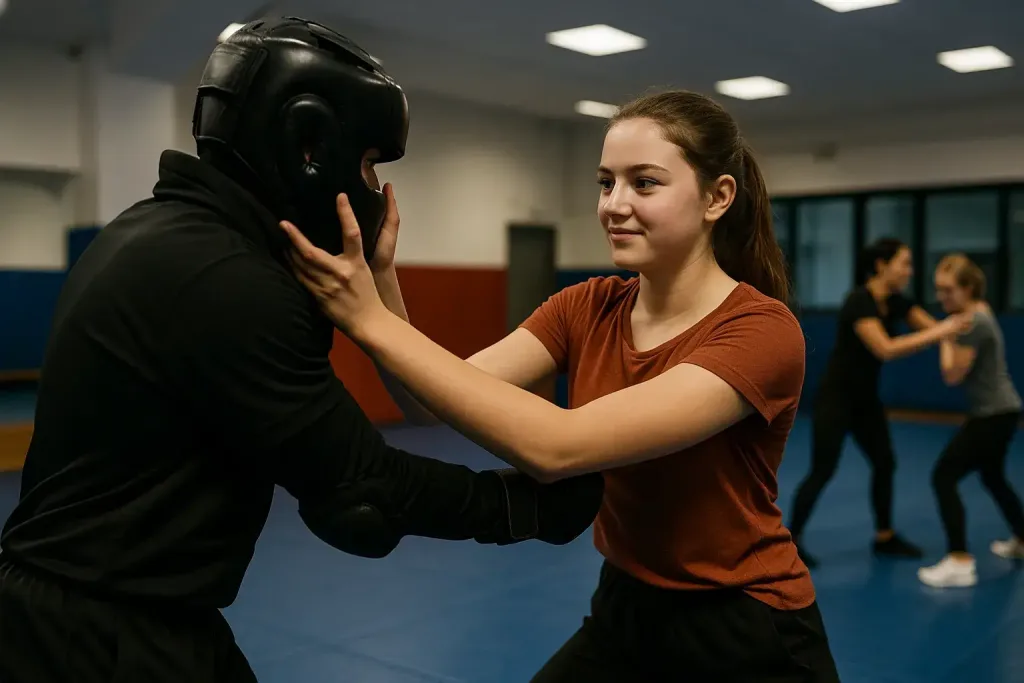
— Week 4: Simple, high‑percentage self‑defense techniques (wrist escapes, break grips, push‑away basics).
— Week 5: Defending against grabs and chokes; safe ground escapes; emphasize escape over fight.
— Week 6: Personal safety tech: phone safety, personal alarms, safe use of legal self‑defense tools.
— Week 7: Basic first aid I — primary survey, calling help, controlling bleeding, shock prevention.
— Week 8: Basic first aid II — CPR overview, airway obstruction (choking), treating hypothermia and frostbite, final practical assessment.
Adaptations:
— Kids (6–12): focus on boundaries, saying “no”, escape to safe adult, stranger‑danger scenarios, simple physical skills and delegation to parents.
— Teens: include digital safety, peer pressure, nightlife scenarios.
— Seniors: balance, fall prevention, gentle techniques, first aid for common geriatric emergencies.
— Women‑focused: situational awareness, partner drills emphasizing escape, confidence building, transit safety.
First aid essentials to teach (practical, prioritized)
— Scene safety and calling 112.
— Primary survey: responsiveness, breathing, circulation.
— Severe bleeding control: direct pressure, wound packing basics, tourniquet awareness (training required).
— CPR basics: hands‑only CPR introduction and when to apply full CPR; use of AED if available.
— Choking: Heimlich/abdominal thrust alternatives for different ages/conditions.
— Burns, frostbite, hypothermia: what to do and what NOT to do.
— Shock recognition and positioning.
— Seizure and stroke recognition (FAST/other local signs), allergic reaction basic management (antihistamines vs. epinephrine awareness).
— When to hand over to EMS and documentation for rescuers.
Encourage participants to take certified first‑aid courses (e.g., Russian Red Cross and local hospital/EMS programs) for formal credentials.
Instructor and facility requirements
— Instructors: certified martial arts/self‑defense coaches, trauma‑informed trainers, and at least one qualified first‑aid instructor per course. Background checks recommended.
— Space: gym halls, community centers, dojos, parks (spring–autumn) with mats and first‑aid kit. Popular venues in Moscow include local sport complexes, university gyms, and municipal cultural centers.
— Equipment